
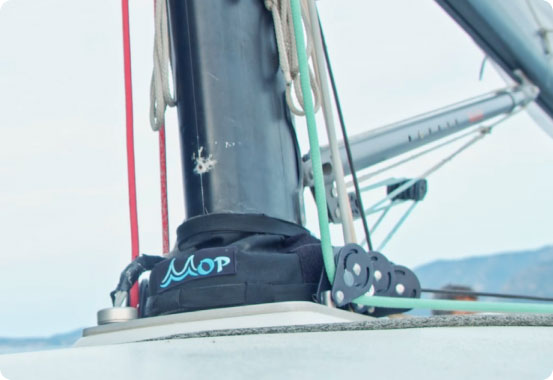
The sealing of a keel-stepped mast may seem simple: a mast, a deck opening, a seal… and water that must not pass through. In reality, on a sailboat, this area involves a more subtle technical specificity: the mast boot must maintain a durable seal around a structural element of the boat that is constantly “working.”
The interface between the mast and the deck must not only resist water: it must also withstand movement, compression, load variations, and the aging of materials. To understand why the sealing of a keel-stepped mast is sometimes compromised, the MOP team suggests looking back at how the rigging itself functions.
Why is sealing a keel-stepped mast complex?
Sealing a keel-stepped mast is complex because the mast must remain free to move while preventing water from entering the boat. The sealing system must therefore withstand mechanical stress, humidity, salt, UV rays, and the aging of materials.
Key takeaways – Sealing a keel-stepped mast
The sealing of a keel-stepped mast relies on a delicate technical balance: water must be prevented from entering the interior of the boat while allowing the mast the freedom to work. This area, located at the partners, is subject to permanent mechanical constraints—compression, flexion, relative movements—to which are added the aggressions of the marine environment—humidity, salt, UV rays, temperature variations…
Over time, the original seal gradually loses flexibility and effectiveness. Leaks appear on many sailboats. For the owner seeking a technically coherent, durable solution adapted to the reality of the boat, MOP is a keel-stepped mast sealing solution to consider.
How does a keel-stepped mast work?
Unlike a deck-stepped mast, a keel-stepped mast does not stop at an external base: the rigging element passes through the deck to rest further down within the structure of the boat.
On the deck, the mast passes through a specific opening: the partners. Between the mast and the partners, a space is maintained to ensure that the movements of the rigging do not generate destructive pressure on the structure. The partners must both allow for the mechanical play of the mast and be able to accommodate a sealing system capable of preventing the entry of fresh and salt water.
Why are the partners considered a mechanically complex area?
A keel-stepped mast never works under static conditions: even when movements are barely visible, they exist. During navigation, they are omnipresent.
The mast undergoes stresses related to the rigging. It absorbs:
- Lateral forces
- Variations in trim, heel, and load
- Vibrations.
The mast passage area must always remain watertight, despite these movements. An excessively rigid solution therefore quickly reaches its limits.
What stresses are exerted on a mast base?
The mast base area undergoes dynamic stresses related to the movements of the rigging and the boat:
- Compression: the mast transmits vertical forces toward its base under the effect of rigging tension
- Flexion: the mast deforms slightly according to loads, points of sail, heel, and sea conditions
- Relative movement: the mast and the deck passage area never remain perfectly fixed relative to one another.
Environmental constraints, particularly related to UV rays, sea salt, humidity, rain runoff, and thermal cycles, are also added.
Keel-stepped mast sealing: why do materials age?
The sealing system ages because it is exposed to mechanical fatigue and the marine environment. UV rays harden the materials, salt and humidity degrade them, temperature variations fatigue them… and repeated micro-movements eventually cause them to lose part of their elasticity.
The seal stiffens, becomes marked, cracks, or fails to return to its original shape. Its effectiveness begins to decline until the seal is lost.
Also read: Mast Step Leak – Causes, Risks, and Solutions for Through-Deck Mast Sailboats
What are the limitations of the original cylindrical seal?
On all keel-stepped mast sailboats, the mast boot is a wear part. In the original version, it is often cylindrical in shape and held in place by tightening. Its geometry depends on the quality of the material and its ability to maintain its initial behavior over time.
Replacing the seal with an identical one requires unstepping the mast.
Mast base sealing system: what are the qualities of an effective solution?
To function correctly, a sealing solution for a keel-stepped mast must meet several criteria:
- Accept movement
- Withstand the marine environment
- Be durable
- Avoid creating new constraints
- Remain compatible with the practical use of the boat.
An innovative and less restrictive sealing solution
Until now, owners of keel-stepped mast sailboats facing leaks had two choices:
- Restore the seal at the mast passage using makeshift methods that are rarely conclusive, by repairing or resealing it regularly
- Replace the deteriorated seal with a new part, which involves unstepping and restepping the mast.
See also: Replacing a mast boot, is it necessary to unstep the mast? Comparison of solutions
MOP, a new sealing solution for the mast boot
Today, a new solution exists—as technically serious as replacing it with an original part, but much easier, faster, and more economical to implement.
Thus, the MOP sealing equipment:
- Includes materials and a logic compatible with the mechanical reality of the area
- Ensures a seal for more than 98% of mass-produced masts
- Does not require unstepping the mast for installation.


