
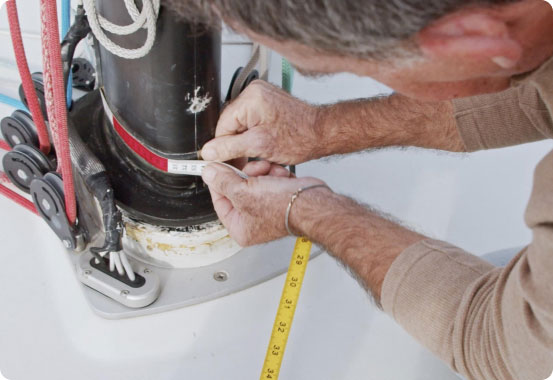
Mast Step Leaks
Are mast step leaks common on deck-stepped mast sailboats?
Yes. The mast step of a deck-stepped mast sailboat is a sensitive area that regularly experiences sealing issues. It is not uncommon to encounter some mast step leaks when the seal is nearing the end of its service life.
Is a small crack in the mast step seal serious?
Yes, even a minor crack in the seal between the mast and the deck can be enough to compromise watertightness. Especially if the material is already fatigued!
In case of a mast step leak, should action be taken immediately?
If water ingress is detected, it is advisable to diagnose the problem precisely, then address the lack of watertightness without delay.
Are there solutions that do not require unstepping the mast?
Yes. Devices such as mop allow you to address the sealing of the mast/deck passage without removing the mast.
How to Maintain a Mast Step Seal?
How often should the sealing component be inspected?
It is also recommended to check the contact area between the mast and the deck at least at the beginning and middle of the season. An inspection can also be performed after a significant event—heavy rain, thorough rinsing, intensive sailing…—or in case of moisture on board.
What signs of wear should raise concern?
Any change from the seal’s usual appearance should prompt investigation: loss of flexibility or material uniformity, cracks or crazing, hardening, deformation, or less effective retention, for example, should be cause for concern.
Can there be a leak without a large crack?
Yes. A weakness in the seal invisible to the naked eye is sometimes enough to compromise the component’s watertightness.
Should you wait for water to infiltrate before taking action?
No. A preventive approach can be appropriate at the first signs of aging. mop sealing solutions, for example, allow you to act preventively—before the first leaks occur.
How to Replace a Mast Step Seal?
Can sealing be sufficient to restore watertightness at the mast partner level?
We do not recommend sealing the seal, or only as a temporary repair measure. Sealing does not adapt well to the mechanical movements of the rigging and thermal stresses. In our view, it does not constitute a lasting solution.
Is it always necessary to unstep the mast to replace the seal at the mast step?
No. While traditional replacement requires unstepping the mast, this is not the only option: external equipment exists that allows you to restore the area’s watertightness in a few minutes, without removing the mast.
What is the main disadvantage of replacing a seal by unstepping the mast?
The main disadvantages of replacing a mast step seal by unstepping the mast are boat immobilization, logistics, and the overall cost of the work.
When is a sealing solution without unstepping the mast appropriate?
Replacing a mast step seal without unstepping the mast allows you to address leaks quickly, simply, and economically. This option avoids having to resort to a major operation, while maintaining a genuine requirement for reliability and durability.
Deck-Stepped Mast Sealing
What is a deck-stepped mast?
A deck-stepped mast passes through the deck of a sailboat to rest lower down in the boat’s structure.
What is the mast partner on a boat?
The mast partner of a sailboat refers to the framing of the mast passage at deck level. It is an essential technical point for managing watertightness on a deck-stepped mast sailboat.
Why does the deck-stepped mast sometimes cause sealing problems?
When the sailboat has a deck-stepped mast, a space is maintained at the deck passage level to allow the rigging to work. This space is sealed by means of a mast step seal which, when deteriorated, may no longer ensure proper watertightness.
Why does the original seal age?
The sealing system of a boat’s mast inevitably deteriorates under the combined effects of UV rays, salt, moisture, temperature variations, and the boat’s constant micro-movements. With age, even good material eventually loses flexibility and effectiveness. This phenomenon is even faster with a black or carbon mast, which is subjected to significant heat.
Is it absolutely necessary to unstep the mast to restore proper watertightness?
No. Replacing the original mast step seal may involve unstepping the mast, but technical solutions such as mop now allow intervention without removing the mast.


